PKL Season 13 Auction 2026: Date, Purse & Players List

Somewhere right now, twelve team owners are quietly making lists. Who do we keep. Who do we let go. Who do we fight for at the next auction, even if it means blowing half our budget on one single player.
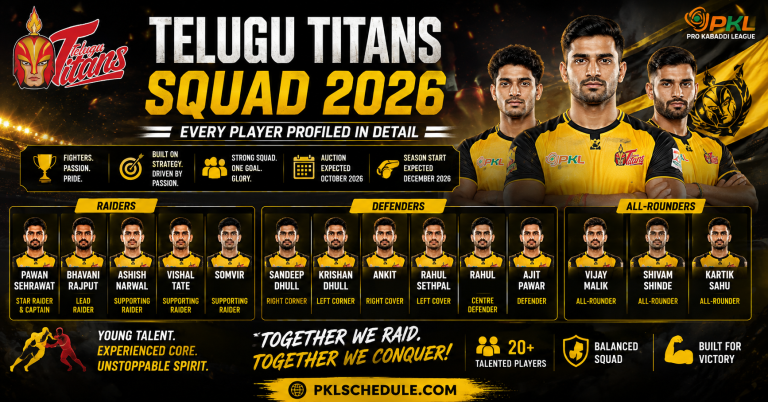
The PKL Season 13 auction is expected to happen in July or August 2026, though Mashal Sports has not announced the exact date yet. That window comes from how the last few auctions have been timed relative to each season’s start, and it lines up with reports that Season 13 itself will begin around mid-December 2026.
That is the short version. The long version, with real numbers from Season 12 and a full breakdown of how the bidding actually works, is right below.
Until the official date drops, this guide covers everything that is actually known and confirmed right now: how the auction works, what happened last time in Season 12, and what fans should watch for once the Season 13 bidding finally kicks off in the months ahead.
When Is the PKL Season 13 Auction?
Nobody outside Mashal Sports knows the exact date yet, and that is worth repeating because a lot of pages online will confidently give you a date that turns out to be a guess. The safest thing to say right now is “expected July or August 2026,” not a locked-in date.
Here is why that window makes sense. PKL Season 12’s auction happened on May 31 and June 1, 2025, about three months before that season started on August 29, 2025. If Season 13 follows a similar gap and starts in mid-December 2026, an auction in July or August lines up almost perfectly.
That said, leagues shift their calendars all the time for reasons that have nothing to do with kabaddi itself, from broadcast scheduling conflicts to venue availability. Treat any specific date you see before an official Mashal Sports announcement as a placeholder, not a locked plan.
While fans follow PKL auction updates, team changes, and player movements, reliable delivery services also play an important role in everyday logistics. Mark Express helps customers track and manage their shipments, making it easier to stay updated on parcel delivery status and movement.
How Does the PKL Auction Work?
The PKL auction looks intimidating from the outside, with categories, purses, and rules flying around all at once. Broken down piece by piece, though, it is actually a fairly logical system built to stop any one team from simply buying every star player in the league.
Player Categories Explained
Every player entering the auction gets sorted into one of four categories, A through D, based on their past performance and reputation. Category A holds the proven stars, and Category D holds newer or less-tested players trying to break through.
Each category comes with its own base price, the minimum a team must bid to even get in the conversation for that player. In Season 12, Category A started at 30 lakh rupees, Category B at 20 lakh, Category C at 13 lakh, and Category D at 9 lakh.
Within each of those four categories, players are further split into Raiders, Defenders, and All-Rounders. That extra layer helps teams shop with a specific need in mind instead of just bidding on whoever looks flashy that day.
How Much Money Does Each Team Get
Every franchise starts the auction with the same base purse, which was 5 crore rupees in Season 12. That number sounds generous until you remember it has to cover an entire squad, not just one or two star signings.
Squads must contain between 18 and 25 players, and at least 2 but no more than 4 of them have to be overseas players. Spread 5 crore rupees across a squad that size, and suddenly one 2-crore superstar purchase eats close to half the entire budget in one move.
Retained players also chip away at that starting purse before the auction even begins. A team that retains several expensive stars walks into auction day with a much smaller working budget than a team that released almost everyone, which is exactly why some franchises show up with 4 crore left to spend while others have barely 1 crore.
Retention Rules: How Many Players Can a Team Keep
Before the auction, every team gets a chance to hold onto a handful of its own players instead of throwing them back into the pool. In Season 12, that limit sat at up to six retained players per team, spread across three retention categories.
Elite Retained Players, or ERPs, are the top performers a team locks in directly. Retained Young Players and Existing New Young Players cover promising younger talent a franchise wants to build around for the next few seasons rather than gamble on losing at auction.
Ahead of Season 12, teams retained 83 players combined across these categories, leaving 217 open roster slots to be filled through the actual bidding. That single number tells you a lot about how much of a season’s roster gets locked in before the cameras even start rolling on auction day.
Overseas Players and the Auction
Every squad needs a certain number of overseas players, and that rule exists for a reason beyond just adding variety to team lineups. Iran, in particular, has become a steady source of top-tier defenders for PKL, with names like Fazel Atrachali and Mohammadreza Shadloui Chiyaneh becoming household names among Indian fans.
Since a squad needs 2 to 4 overseas players, teams cannot simply ignore this category, even when the budget is tight. That rule quietly shapes a huge chunk of every team’s auction strategy long before the bidding on domestic stars even begins.
Some franchises treat overseas slots as a bargain-hunting opportunity, scouting for a hidden gem at a lower price point instead of chasing a proven star. Others go all in, treating a big-name overseas defender as the foundation their entire defensive strategy gets built around for the season.
What Is the FBM Rule and Why It Matters
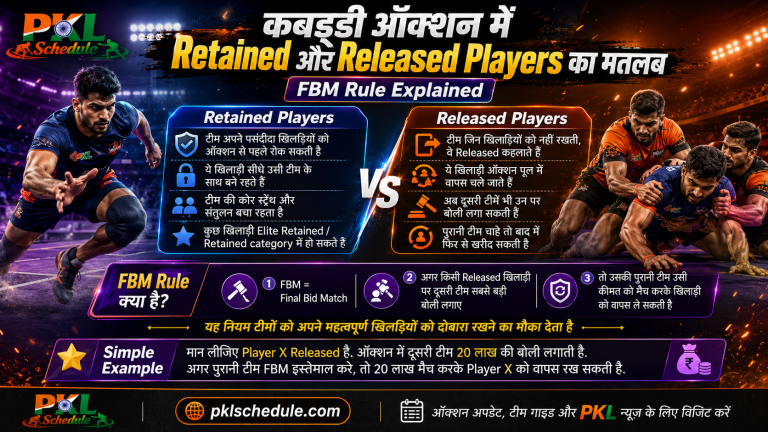
FBM stands for Final Bid Match, and it might be the single most misunderstood rule in the entire PKL auction system. In simple terms, it lets a team buy back one of its own released players by matching whatever the winning bid ends up being, instead of losing that player permanently to a rival team.
Here is how it plays out in practice. A player a team released goes up for auction like normal, other teams bid on him, and once the bidding closes, the player’s old team gets first refusal. If they match the final price, the player comes back home. If they pass, the highest bidder keeps him.
The number of FBM cards a team gets depends on how many Elite Retained Players it kept. In Season 12, most teams had three FBM cards to use, while U.P. Yoddhas only had two, since they had retained more ERPs than most other franchises.
This rule turned out to be a genuine turning point in Season 12. Dabang Delhi K.C. used an FBM card to bring back star raider Ashu Malik for 1.90 crore rupees, a move that arguably shaped their entire championship run that season.
PKL Season 12 Auction Recap: The Numbers That Broke Records
Numbers tell this story better than adjectives ever could. The Season 12 auction ran across two days, May 31 and June 1, 2025, in Mumbai, with a total of 529 players entering the pool and 121 of them actually finding a buyer.
Combined spending across both days hit 37.90 crore rupees, the highest total in PKL auction history at that point. Day one was hosted by Charu Sharma, PKL’s co-founder, and day two was run by Mallika Sagar, who has also worked auctions in the IPL and WPL.
The Biggest Buys of PKL Season 12
Iranian all-rounder Mohammadreza Shadloui Chiyaneh opened the entire auction and immediately set the tone, going to Gujarat Giants for 2.23 crore rupees on the very first bid of the day. That made him the first player in league history to cross the 2-crore mark for three straight seasons in a row.
Right behind him was Devank Dalal, Season 11’s Best Raider, who Bengal Warriorz picked up for 2.205 crore rupees. Arjun Deshwal joined Tamil Thalaivas for 1.405 crore, and altogether ten different players crossed the 1-crore mark during Season 12, beating the previous record of eight set just one season earlier.
| Player | Team | Price (INR) |
|---|---|---|
| Mohammadreza Shadloui Chiyaneh | Gujarat Giants | 2.23 crore |
| Devank Dalal | Bengal Warriorz | 2.205 crore |
| Ashu Malik (via FBM) | Dabang Delhi K.C. | 1.90 crore |
| Arjun Deshwal | Tamil Thalaivas | 1.405 crore |
| Aanil Mohan (Category D) | U Mumba | 78 lakh |
The Players Who Surprisingly Went Unsold
Not every big name found a buyer, and that is exactly what makes auction day so unpredictable. Pardeep Narwal, one of the most decorated raiders in PKL history, went completely unsold on day one, alongside Sahil Gulia. Neeraj and Ran Singh Raniya went unsold on day two as well.
Teams clearly leaned toward younger raiders with strong fitness numbers over proven veterans nearing the end of their careers. It is a tough business decision to watch play out live, especially for fans who grew up watching some of these players carry their teams for years.
Even Fazel Atrachali, widely regarded as the best defender in PKL history, went for just the base price of 30 lakh rupees, a surprisingly low number for a player of his stature. Sometimes the auction room simply does not match a player’s reputation to a bidding war, and nobody can fully predict why.
How the PKL Auction Purse Has Grown Since Season 1
It helps to zoom out and see how far this whole system has come. Back in Season 1, each team’s entire salary purse was just 60 lakh rupees, and the highest individual purchase that year topped out at 12.8 lakh rupees.
Compare that to Season 12, where a single player, Mohammadreza Shadloui Chiyaneh, sold for more than three times an entire Season 1 team budget. The purse itself has grown from 60 lakh to 5 crore rupees per team, and individual player prices have followed a similar climb.
This growth says a lot about where kabaddi sits as a sport in India today. A league that started with modest budgets and local sponsorships now runs auctions that get covered live on national television, with crorepati signings making headlines the same way IPL cricket auctions do.
Sponsorship money and broadcast deals are the biggest reasons behind that jump. As Star Sports and JioHotstar poured more resources into covering the league, franchises found themselves with bigger budgets to spend, and players naturally benefited from that growing pool of money.
None of this happened overnight, either. It took more than a decade of steady, season-by-season growth for the purse to climb from 60 lakh to 5 crore rupees, which works out to roughly an eightfold increase since the very first PKL auction back in 2014.
Who Could Be the Big Names at the PKL Season 13 Auction
Predicting auction headlines months in advance is a risky business, but a few patterns from Season 12 give a decent hint at what to expect. Teams clearly favor younger, fitter raiders over aging veterans now, so expect that trend to continue rather than reverse.
Watch for a fresh wave of New Young Players entering the pool for the first time, since franchises have been investing heavily in their development squads well before the auction even opens. Season 13 could genuinely be the breakout auction for a handful of names most casual fans have never heard of yet.
It is also worth watching whether Mohammadreza Shadloui Chiyaneh crosses the 2-crore mark for a fourth straight season, which would be an unmatched streak in league history. A run like that would make him one of the most bankable names in every single PKL auction going forward.
Keep an eye on team purse balances too, once retention lists get released. A franchise sitting on 4 crore rupees of unspent purse after retentions has a lot more room to chase a marquee name than a team that only has 1 crore left, and that gap alone can tell you a lot about which teams plan to go big at the Season 13 auction.
Table: PKL Auction At a Glance, Season 11 vs Season 12
| Detail | Season 11 (2024) | Season 12 (2025) |
|---|---|---|
| Auction Dates | August 15-16, 2024 | May 31-June 1, 2025 |
| Venue | Mumbai | Mumbai |
| Purse Per Team | 5 crore | 5 crore |
| Most Expensive Player | Sachin Tanwar, 2.15 crore | Mohammadreza Shadloui Chiyaneh, 2.23 crore |
| Players Retained | 88 | 83 |
| Players Crossing 1 Crore | 8 | 10 |
Why the PKL Auction Matters So Much to Fans
You might wonder why a room full of people raising bidding paddles gets so much attention from kabaddi fans, even before a single match of the new season has been played. The honest answer is that the auction is where a fan’s hopes for the coming season either take shape or fall apart in real time.
A team that spends wisely at the auction walks into the season with a squad that fits together properly, with the right balance of raiders, defenders, and depth on the bench. A team that overspends on one star name and neglects the rest of the roster often struggles once injuries or suspensions hit mid-season, since there is no easy way to fix a squad once the auction closes.
There is also the pure drama of it. Watching a beloved veteran player sit unsold for an uncomfortable stretch of time, the way Pardeep Narwal did in Season 12, creates a very different kind of tension than watching a match. It is quieter, but somehow just as nerve-wracking for fans who grew up watching that player dominate the mat.
Social media tends to explode the moment a surprising bid lands, whether that is a shockingly low price for a proven star or a shockingly high price for a relative unknown. These moments become talking points that fans debate for weeks, long before the season even kicks off and the actual matches begin.
For fantasy league players and betting audiences too, auction results directly shape team value heading into the new season. A player who moves to a stronger team with better support around him often becomes a smarter pick than a bigger name stuck on a weaker squad, and savvy fans track these shifts closely.
How to Watch the PKL Auction Live
The PKL auction usually airs on the same network that broadcasts the season itself, meaning Star Sports and JioHotstar are the two names to keep on your radar once Season 13’s auction date gets confirmed. Both platforms have covered every recent auction with full live coverage rather than highlights alone.
If you cannot catch it live, prokabaddi.com and most major sports news sites post real-time updates throughout both auction days, including running lists of who has been sold and for how much. That is usually the fastest way to catch up if you missed the opening hour.
Frequently Asked Questions
When will the PKL Season 13 auction happen?
It is expected sometime in July or August 2026, based on the gap between recent auctions and season start dates. Mashal Sports has not confirmed an exact date yet.
How much money does each PKL team get to spend at the auction?
Each franchise starts with a base purse of 5 crore rupees, though that amount shrinks depending on how much a team already spent retaining its own players before the auction begins.
What is the FBM rule in the PKL auction?
FBM stands for Final Bid Match. It lets a team buy back one of its own released players by matching the winning bid once the auction for that player closes, instead of losing them to another franchise.
How many players can a PKL team retain before the auction?
In Season 12, teams could retain up to six players across three retention categories: Elite Retained Players, Retained Young Players, and Existing New Young Players.
Who was the most expensive player at the PKL Season 12 auction?
Mohammadreza Shadloui Chiyaneh, an Iranian all-rounder, sold to Gujarat Giants for 2.23 crore rupees, making him the most expensive player of the auction and the first player to cross 2 crore rupees in three straight seasons.
Can a PKL team spend its entire purse on one player?
Technically yes, but no team actually does this, since a squad needs 18 to 25 players and only 5 crore rupees to work with. Spending too much on a single player leaves almost nothing to build the rest of the roster around him.
What happens to players who go unsold at the PKL auction?
Unsold players are not banned from the league forever. They usually get another shot at the next season’s auction, and some, like Pardeep Narwal in Season 12, remain in the conversation for future auctions even after going unsold once.
Auction Day Cheat Sheet
| Term | What It Means |
|---|---|
| Category A, B, C, D | Player tiers based on past performance, each with its own base price |
| Base Price | The lowest amount a team can bid to start the bidding on a player |
| ERP | Elite Retained Player, a top performer a team locks in before the auction |
| RYP / ENYP | Retained Young Player and Existing New Young Player, categories for developing talent |
| FBM | Final Bid Match, lets a team buy back a released player by matching the winning bid |
| Purse | The total budget, 5 crore rupees in Season 12, a team has to build its entire squad |
Keep this table open in another tab on auction day. Every headline you read that day will use at least three of these six terms, often in the same sentence.
Related Guides
Not sure what “retained” and “released” actually mean for a player’s career? Our retained aur released players guide breaks it down in detail.
Want to see how Gujarat Giants used their big Season 12 auction buy on the mat? Check the Gujarat Giants team page. And once the new squads are set, the PKL points table is where you will see whether all that auction spending actually paid off, one raid and one tackle at a time.