Commonwealth Kabaddi Championship 2026: Dates, Host Nation, Participating Teams and Why This Tournament Pushed the PKL Season 13 Auction Into Late October
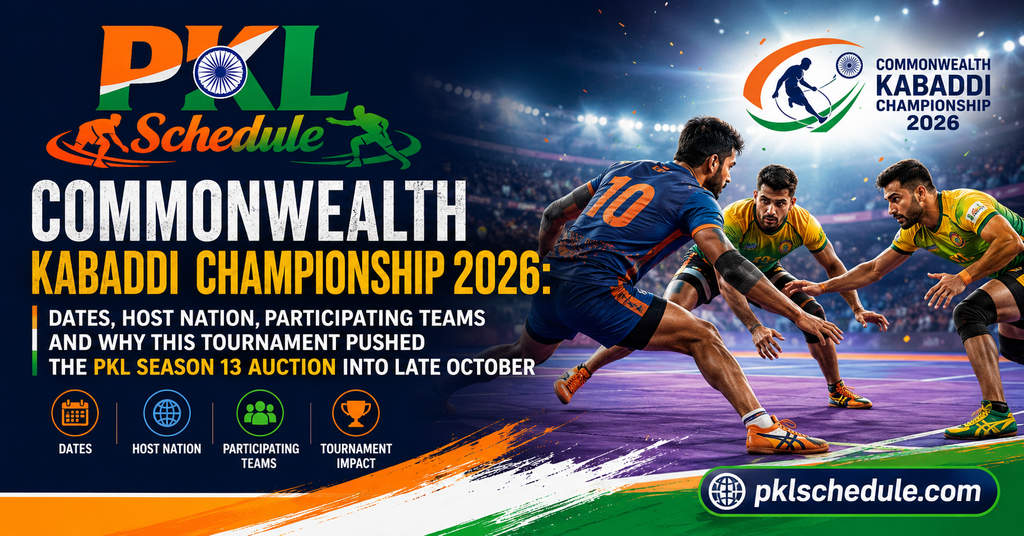
Quick answer: The Commonwealth Kabaddi Championship 2026 is scheduled for 10 to 18 October 2026 in India. It falls between the Asian Games in September and the expected PKL Season 13 auction in late October, and it is one of the two tournaments responsible for pushing the domestic league season into December.
Commonwealth Kabaddi Championship 2026 key details
| Detail | Information |
|---|---|
| Dates | 10–18 October 2026 |
| Host nation | India |
| Position in calendar | After the Asian Games, before the PKL auction |
| Duration | Nine days |
The championship sits in a nine-day window that begins roughly two weeks after the Asian Games kabaddi competition concludes on 26 September. For India’s leading players, that is an extremely compressed turnaround between two international tournaments.
The 2026 international kabaddi calendar in full
To understand why this tournament matters, you have to see the whole year at once. 2026 is the most congested international kabaddi calendar in the sport’s modern history.
| Tournament | Dates | Location |
|---|---|---|
| 20th Asian Games (men & women) | 21–26 September 2026 | Aichi-Nagoya, Japan |
| Commonwealth Kabaddi Championship | 10–18 October 2026 | India |
| 6th Asian Indoor & Martial Arts Games | 28 November – 7 December 2026 | Saudi Arabia |
Three international tournaments across roughly eleven weeks. For a sport whose elite Indian playing pool numbers in the low hundreds, that is an enormous load — and it collides directly with the domestic league’s normal operating calendar.
Why this tournament delayed the PKL Season 13 auction
This is the connection almost no coverage makes explicit, and it is the reason this page exists.
Earlier in 2026, the PKL Season 13 auction was widely reported as happening in a July or August window. It has since drifted twice. Current reporting places it between 18 and 25 October 2026, with the season expected to begin around December.
The reason is straightforward once you look at the calendar above. A franchise auction requires the players being bought to be available for medical checks, contract signing and pre-season camps. Running an auction while India’s best raiders and defenders are in Japan, and then in a Commonwealth Championship at home, is logistically impossible.
The Commonwealth Championship window of 10–18 October explains the specific auction dates being reported. An auction on 18–25 October begins the day the Commonwealth Championship ends. That is not a coincidence — it is the first available slot on the calendar.
Our Season 13 auction tracker follows the confirmed dates as Mashal Sports announces them.
What a late auction changes about the bidding
The timing shift has consequences beyond scheduling, and franchises are already adjusting for them.
Franchises will bid with fresh evidence. Season 12’s auction took place in May, three months before competitive kabaddi resumed. Bidders were working from the previous season’s data. A late-October auction happens after two full international tournaments, meaning every marquee Indian player will have played high-stakes kabaddi within weeks of the bidding.
Injury risk sits on the wrong side of the auction. A player who picks up a knock in Japan or at the Commonwealth Championship carries that into the bidding room. Franchises will discount aggressively, and some players will go unsold who would otherwise have attracted competitive bids.
Young players have a shop window. The flip side. A raider without an established price who performs at continental level in September and October arrives at the auction table with fresh, visible evidence. This is the single best cycle in years for a breakout player to raise their valuation.
Pre-season is compressed. Teams normally run camps for more than a month after an auction. An 18–25 October auction followed by a December season start leaves roughly six to seven weeks. That is workable, but it favours franchises who retained a settled core over franchises attempting a full rebuild.
How the Commonwealth Championship differs from the Asian Games
The two tournaments occupy different positions in the sport’s hierarchy and attract different fields.
The Asian Games is a continental multi-sport event under the Olympic Council of Asia, and it is the most prestigious title available in kabaddi. It brings Iran, Korea, Japan and Chinese Taipei — the strongest non-South-Asian kabaddi nations.
The Commonwealth Championship draws from Commonwealth member nations, which shifts the competitive field substantially. Iran, as a non-Commonwealth nation, does not compete. That removes India’s most serious rival and changes the character of the tournament: the field skews towards South Asian and diaspora-strong nations, with England, Canada and Kenya among the countries that have historically fielded kabaddi teams at Commonwealth level.
Being hosted in India adds a further dimension — home crowds, familiar mat conditions, and no travel or acclimatisation burden for the Indian squad.
What it means for squad selection
Nine days of competition beginning two weeks after the Asian Games creates a genuine rotation question. Selectors have a decision to make: send the same twelve players who competed in Japan, or rotate.
The argument for rotation is straightforward. A player who reaches the Asian Games final on 26 September and then plays a nine-day Commonwealth Championship from 10 October arrives at an auction on 18 October with almost no recovery. Franchises will notice the workload.
The argument against is equally clear. The Commonwealth Championship is a title India will be expected to win on home soil, and fringe selections carry risk.
The most likely outcome is a partial rotation — a core of established names supplemented by players who missed Asian Games selection and now have a platform immediately before the auction. For anyone tracking auction value, that second group is where the interesting movement will happen.
Why the international calendar matters to domestic fans
If your interest in kabaddi is primarily the domestic league, it is easy to treat international tournaments as background noise. In 2026 that is a mistake, because the international calendar has directly determined the domestic one.
The season has moved from its usual August window to an expected December start. The auction has moved twice. Franchise pre-season camps have been compressed. Every one of those changes traces back to three international tournaments occupying September, October and late November.
For the wider picture of how these events fit together, see our kabaddi international events guide.
What the Commonwealth Kabaddi Championship is
The Commonwealth Kabaddi Championship is a standalone international tournament contested by kabaddi-playing nations within the Commonwealth. It is distinct from the Commonwealth Games — kabaddi is not part of the core Commonwealth Games programme — and operates as its own event on the international kabaddi calendar.
The competitive field is shaped entirely by Commonwealth membership, which produces a very different tournament from the Asian Games. India, Pakistan, Bangladesh and Sri Lanka form the South Asian core. England, Canada, Australia and Kenya have fielded teams built substantially around diaspora communities, where kabaddi has been sustained through community clubs and regional tournaments.
The absence of Iran is the defining structural feature. Iran is the only nation to have beaten India in a major international final in recent years, and their non-participation changes both the difficulty and the character of the competition.
Why India hosting matters
Hosting removes several variables that affect touring squads: travel fatigue, unfamiliar mat surfaces, time-zone adjustment and crowd hostility. For a squad arriving directly from a demanding Asian Games campaign in Japan, playing at home is a meaningful practical advantage.
It also matters commercially. A home international tournament in the weeks immediately before a franchise auction gives Indian players visibility in front of Indian audiences and Indian franchise scouts, at exactly the moment valuations are being formed.
The player workload problem
Look at the calendar from a player’s perspective rather than an administrator’s, and the 2026 schedule becomes concerning.
An Indian international who reaches the Asian Games final plays six days of competition ending 26 September. The Commonwealth Championship begins 10 October — a gap of fourteen days. That tournament runs nine days to 18 October. The PKL auction is reported for 18 to 25 October. Franchise pre-season camps follow immediately, ahead of an expected December season start.
| Period | Commitment |
|---|---|
| 21–26 September | Asian Games, Japan |
| 27 September – 9 October | Travel and recovery, two weeks |
| 10–18 October | Commonwealth Championship, India |
| 18–25 October | PKL Season 13 auction window |
| Late October – November | Franchise pre-season camps |
| December | Expected PKL Season 13 start |
| 28 November – 7 December | Asian Indoor & Martial Arts Games, Saudi Arabia |
Note the overlap at the bottom of that table. The Asian Indoor and Martial Arts Games run 28 November to 7 December, directly into the expected league start. Any player selected for that event faces a conflict between national duty and franchise commitments in the opening weeks of the season.
Kabaddi is a high-contact sport where corner defenders in particular absorb repeated physical punishment. Three international tournaments and a full league season inside six months is a workload no other franchise sport in India asks of its athletes.
What this means for franchises
Franchise strategy for the Season 13 auction has to account for something it usually does not: recent, heavy international workload on the players being bought.
Fitness due diligence becomes central. A player arriving at the auction three days after a nine-day home tournament, having played an Asian Games two weeks before that, is a different proposition from a player who has been resting since May.
Squad depth gains value. Franchises whose marquee players face Asian Indoor and Martial Arts Games call-ups in late November may start the season without them. Depth signings that would normally be an afterthought become insurance.
Uncapped players become relatively more attractive. A domestic-only player has none of this workload and arrives at pre-season fresh. In a compressed cycle, that has genuine value.
How to follow the tournament
The Commonwealth Championship does not receive the broadcast attention of the Asian Games, and coverage in past editions has been inconsistent. Fixture lists, participating nations and final squad announcements typically emerge in the fortnight before the tournament begins, which places the likely announcement window in late September 2026 — immediately after the Asian Games concludes.
For anyone tracking the auction rather than the tournament, the relevant thing to watch is not results but availability: which players are selected, who is rested, and who picks up a knock. Those three data points will shape bidding more than any scoreline.
Frequently asked questions
When is the Commonwealth Kabaddi Championship 2026?
From 10 to 18 October 2026, hosted in India.
Does Iran compete in the Commonwealth Kabaddi Championship?
No. Iran is not a Commonwealth member nation, so India’s principal international rival does not feature.
How did the Commonwealth Championship affect the PKL auction date?
The championship occupies 10–18 October. Reporting places the PKL Season 13 auction between 18 and 25 October — effectively the first available window once the tournament concludes.
When will PKL Season 13 start?
Reports point to a December 2026 start, following the auction in late October and roughly six weeks of franchise pre-season camps. Mashal Sports has not confirmed an official date.
Will India’s Asian Games squad also play the Commonwealth Championship?
Squads had not been announced at the time of writing. A partial rotation is likely, given the compressed turnaround and the auction that follows immediately afterwards.
What other kabaddi tournaments are scheduled in 2026?
The 6th Asian Indoor and Martial Arts Games in Saudi Arabia from 28 November to 7 December, alongside the Asian Games in September and the Commonwealth Championship in October.
Is the Commonwealth Kabaddi Championship part of the Commonwealth Games?
No. Kabaddi is not on the core Commonwealth Games programme. The championship is a standalone international tournament organised separately for Commonwealth member nations.
Which countries compete in the Commonwealth Kabaddi Championship?
The field is drawn from Commonwealth members. India, Pakistan, Bangladesh and Sri Lanka form the South Asian core, with England, Canada, Australia and Kenya among the nations that have fielded teams built largely around diaspora communities.
Background on the Commonwealth Games movement and its member nations is available at the Commonwealth Games Federation entry on Wikipedia.