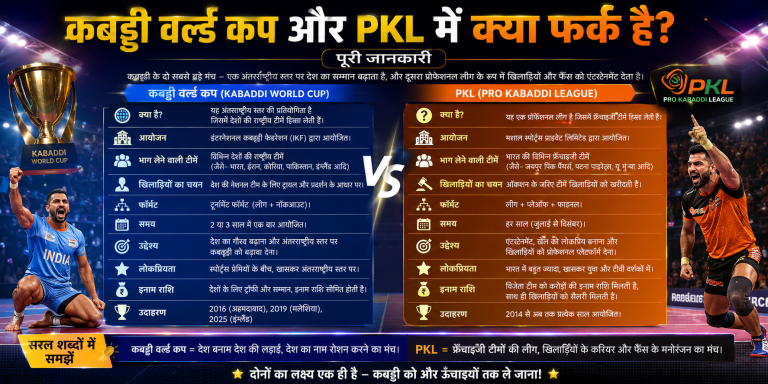
PKL Playoffs Schedule: Eliminator, Qualifier & Final Guide
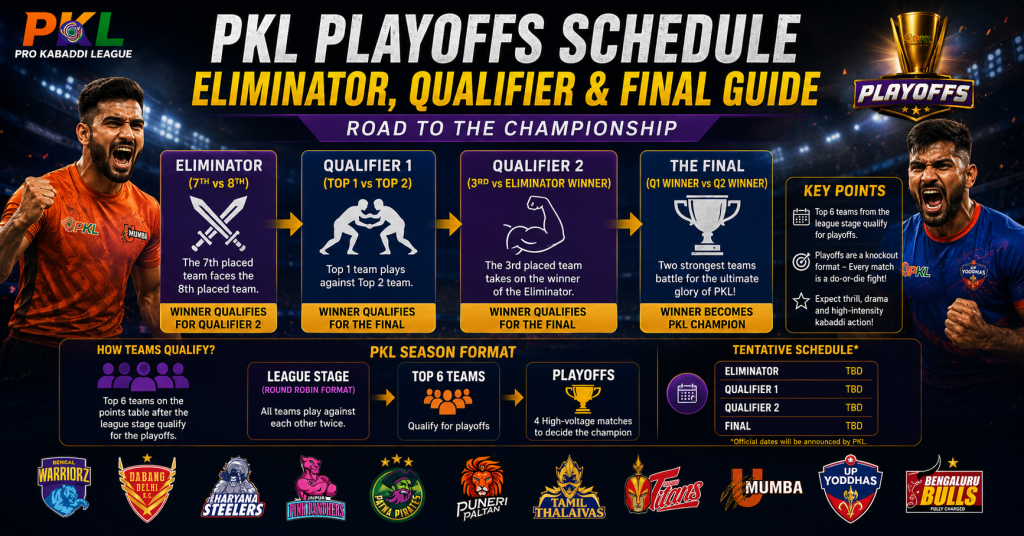
You watched the whole PKL league stage. Every raid, every tackle, every last-second bonus point. Then the words “Play-in” and “Qualifier 2” show up on your screen and suddenly it feels like someone switched the rules on you halfway through the movie.
You are not alone. Even long-time kabaddi fans get confused by the PKL playoffs schedule because the format keeps changing almost every season. One year it is a simple four-match knockout, and the next year it turns into a nine-match maze spread across an entire week, with new terms thrown in every time you get comfortable with the last set.
This guide breaks the whole thing down in plain language, step by step, so you know exactly which team needs to win what, and when. No jargon, no confusing brackets thrown at you all at once, just a clear walk through every round in the order it actually happens.
What Is the PKL Playoffs Schedule?
The PKL playoffs schedule is the final stretch of the season where the top teams from the league stage fight it out to reach the final. Instead of one straight knockout bracket, PKL uses a mix of Play-ins, Eliminators and Qualifiers spread across a single week, usually at one host city.
In Season 12, that meant eight teams out of twelve, not the usual six, got a shot at the title. The playoffs ran for a full week at the Thyagaraj Indoor Stadium in Delhi, from October 25 to October 31, 2025, and ended with Dabang Delhi K.C. beating Puneri Paltan 31-28 in the final.
So when someone asks “what is the PKL playoffs schedule,” the short answer is this: it is a nine-match, week-long mini-tournament inside the tournament, and every match in it is a straight do-or-die game except for the top two teams, who get one small safety net.
How Many Teams Qualify for PKL Playoffs
For most of PKL’s history, only the top six teams from the league table made the playoffs. Season 12 changed that. The league expanded the playoff field to the top eight teams, which meant more franchises got a real shot at the trophy after months of hard league matches.
Here is why that matters for fans. A bigger playoff field means teams sitting in seventh or eighth place with a mediocre season can still sneak in through the Play-in round and catch fire at the right time. That is exactly the kind of chaos that makes knockout kabaddi fun to watch.
It also means the league stage carries more weight than before. Finishing first or second is now worth a lot more than just bragging rights, because those two teams skip the early rounds completely and go straight into Qualifier 1. Everyone else has to fight through at least one extra match to get there.
Whether Season 13 keeps this same eight-team format has not been confirmed yet. Since Mashal Sports only introduced it in Season 12, though, there is a good chance they stick with it for at least one more year before making further changes.
PKL Playoffs Format Explained Step by Step
The easiest way to understand the PKL playoffs is to treat it like a ladder with two separate paths. One path is for the top two teams. The other path is for teams ranked three through eight, and that path has a lot more steps and a lot more danger.
Play-in Round
The Play-in round is the very first hurdle, and only teams that finished fifth through eighth on the league table play in it. There are two Play-in matches, and both are straight knockout games. Lose here, and your season is over, no second chances at all.
The two winners from the Play-in round move on to Eliminator 1. This is the harshest stage of the whole playoffs because these teams have already used up their one shot at redemption before the “real” knockout rounds even begin.
Why the Play-in Round Exists
Before Season 12, teams that finished fifth or lower simply went home once the league stage ended. Adding the Play-in round gave those mid-table teams a reason to keep fighting during the last few league matches instead of coasting once a top-four finish looked out of reach.
Mini-Qualifier
While the Play-in matches are happening, the teams that finished third and fourth play their own separate match called the Mini-Qualifier. This one works a little differently. The winner moves straight ahead in the bracket, but the loser is not eliminated yet.
That loser gets folded back into the Eliminator chain later, which gives third and fourth-placed teams a small cushion that fifth to eighth-placed teams do not get. It rewards a stronger league stage finish without handing out a completely free pass.
Eliminator 1, 2 and 3
This is where the bracket gets busy. Eliminator 1 pits the two Play-in winners against each other. Eliminator 2 takes that winner and pairs them against the team that lost the Mini-Qualifier. Eliminator 3 then takes the Eliminator 2 winner and pairs them against, in some seasons, another team still alive from earlier rounds.
Every single Eliminator match is win-or-go-home. There is no second chance anywhere in this chain, which is exactly why it is called an Eliminator and not a Qualifier. By the time Eliminator 3 finishes, only one team from the bottom half of the bracket survives.
How to Follow the Eliminator Chain Without Getting Lost
A simple trick helps here. Just remember that every Eliminator match removes one more team from contention, and the survivor keeps moving one step closer to Qualifier 2. You do not need to memorize every exact pairing, just track who is still alive after each match.
Qualifier 1 and Qualifier 2
Qualifier 1 is the reward match for finishing first or second in the league stage. Those two teams play each other directly, skipping every Play-in and Eliminator match completely. Whoever wins Qualifier 1 goes straight into the final without playing another game.
The team that loses Qualifier 1 is not out, though. That is the whole point of calling it a Qualifier instead of an Eliminator. They get a second chance in Qualifier 2, where they face whichever team survived the entire Eliminator gauntlet from the bottom half of the bracket.
Qualifier 2 decides the second finalist. Win it, and a team goes from possibly finishing eighth in the league table all the way to the PKL final. Lose it, and the season ends right there, no matter how well that team played all season long.
The Grand Final
The final is the only match in the entire playoffs where both teams have already earned their spot through completely different roads. One team walked a shorter, safer path by finishing in the top two. The other team fought through Play-ins, Eliminators, and a Qualifier just to get there.
That contrast is part of what makes PKL finals so watchable. A team that grinds through five knockout matches in a week often arrives battle-tested and confident, while the top seed comes in fresh but sometimes rusty from the long break since Qualifier 1.
Coaches talk about this openly too. Momentum from back-to-back wins can carry a team through nerves that would normally show up in a one-off final, while a team that has been waiting around for days sometimes needs a few minutes to find its rhythm again under the lights.
PKL Season 12 Playoffs Table
Numbers make this format easier to picture than words alone. Here is exactly how the Season 12 playoffs played out at the Thyagaraj Indoor Stadium in Delhi.
| Date | Round | What Happened |
|---|---|---|
| October 25, 2025 | Play-in 1 & Play-in 2 | Fifth to eighth-placed teams played knockout matches to enter the Eliminator chain. |
| October 26, 2025 | Eliminator 1 | Winners of the two Play-in matches faced off for a spot in Eliminator 2. |
| October 27, 2025 | Eliminator 2 & Qualifier 1 | Eliminator 1 winner played the Mini-Qualifier loser, while Puneri Paltan and Dabang Delhi K.C., the top two teams, met in Qualifier 1. |
| October 28, 2025 | Eliminator 3 | Eliminator 2 winner faced the surviving Mini-Qualifier team for the last spot in Qualifier 2. |
| October 29, 2025 | Qualifier 2 | Qualifier 1 loser faced the Eliminator 3 winner to decide the second finalist. |
| October 31, 2025 | Grand Final | Dabang Delhi K.C. defeated Puneri Paltan 31-28 to win their second PKL title. |
Puneri Paltan actually finished first in the league stage with 13 wins and a plus-88 score difference. Dabang Delhi K.C. matched those 13 wins with a slightly lower score difference, but their tie-breaker win over Puneri in Qualifier 1 sent them straight to the final while Puneri had to grind through Qualifier 2 first.
How the Old PKL Playoff Format Worked
If you followed PKL before Season 12, this whole eight-team system probably feels new and a little overwhelming. Earlier seasons used a much simpler six-team playoff format, and honestly, it is worth knowing both versions since the league could switch back at any point.
The Six-Team Semifinal System Explained
Under the older format, only the top six teams from the league stage made the playoffs. The top two teams got a direct pass into the semifinals, just like they still do in Qualifier 1 today. The other four teams had to fight through two Eliminator matches first.
Eliminator 1 matched the third-placed team against the sixth-placed team. Eliminator 2 matched the fourth-placed team against the fifth-placed team. Both were straight knockout matches with no second chances at all, similar to how the Eliminator chain still works now.
After that, Semifinal 1 paired the Eliminator 1 winner against the first-placed team, and Semifinal 2 paired the Eliminator 2 winner against the second-placed team. The winners of both semifinals then met in the final a couple of days later.
PKL Season 11, played in December 2024, used exactly this format. The semifinals were held on December 27, and the final followed on December 29 at the same venue in Pune. It was tighter and easier to follow than Season 12’s system, though it gave fewer teams a real shot at the title.
PKL Season 13 Playoffs: What to Expect
As of now, Mashal Sports has not confirmed the exact playoff format for Season 13. Based on how recently the eight-team system was introduced, though, there is a fair chance it sticks around for another season rather than getting scrapped after just one year.
What we do know is that Season 13 is expected to keep all 12 franchises from Season 12, with a mega auction likely in July or August 2026 followed by the season itself starting sometime around mid-December 2026. The playoff structure will most likely follow whatever the league decides for the regular season length.
One thing worth watching closely is whether the league keeps the tie-breaker rules from Season 12. Those rules turned out to be a huge factor in deciding who reached the final, since Dabang Delhi K.C. only made it to the final directly because they won a tiebreaker in Qualifier 1.
PKL Playoffs Points and Tie-Breaker Rules
Every playoff match needs a winner, so PKL cannot allow a tie the way league matches sometimes could in older seasons. Since Season 12, in fact, even league matches no longer end in a tie, thanks to a new shootout rule applied across the entire season, not just the playoffs.
When scores are level after regulation time, the match moves into a five-raid shootout. Both teams field seven players each, the baulk line doubles up as a bonus line during the shootout, and five different raiders have to be used, so no single star player can carry the entire shootout alone.
This exact scenario decided Season 12’s biggest playoff shock. Dabang Delhi K.C. and Puneri Paltan finished Qualifier 1 tied 34-34 after regulation, then Delhi won the shootout 6-4 to book a direct spot in the final while Puneri had to take the long way around through Qualifier 2.
PKL Playoff Venues Over the Years
PKL almost always plays its entire playoff week in a single city, rather than moving between venues the way the league stage does. That choice is not random. Playing every playoff match at one arena keeps the crowd energy building night after night, and it also makes broadcast logistics a lot simpler for Star Sports and JioHotstar.
Delhi has hosted the playoffs more than once in recent years, including the entire Season 12 playoff week at the Thyagaraj Indoor Stadium. Pune took over hosting duties for Season 11, with the semifinals and final both played there in December 2024. The host city often, though not always, lines up with where the top-seeded team is based, since that gives the highest-ranked team something close to a home crowd during the biggest matches of the year.
| Season | Playoff Host City | Champion |
|---|---|---|
| Season 12 (2025) | Delhi | Dabang Delhi K.C. |
| Season 11 (2024) | Pune | Haryana Steelers |
| Season 10 (2023-24) | Hyderabad | Puneri Paltan |
| Season 9 (2022) | Mumbai | Jaipur Pink Panthers |
Look closely and you will notice the host city does not always favor the local team. Puneri Paltan hosted the Season 11 playoffs in their own home city and still lost the final to Haryana Steelers, a team with no special home advantage there at all. A playoff venue can lift the crowd noise, but it clearly does not decide the trophy on its own.
Common Playoff Format Questions Fans Get Wrong
A few myths about the PKL playoffs keep popping up on social media every single season, so it is worth clearing them up here before you repeat one of them in a group chat and get corrected by your one friend who watches every single match.
“The Team That Finishes First Always Makes the Final”
Not true, and Season 12 proved it in dramatic fashion. Puneri Paltan finished first in the league stage with 13 wins and the best score difference in the league. They still had to survive Qualifier 2 after losing the tiebreaker in Qualifier 1, and they made the final anyway, just through the harder road.
Finishing first gets you a shortcut through Qualifier 1, not a guaranteed spot in the final. That distinction matters a lot, especially in a shootout-heavy format where one bad five minutes can undo an entire season of dominant league form.
“Losing an Eliminator Means You Still Have a Chance Somewhere”
This one trips up a lot of newer fans, understandably, because the word “Eliminator” sounds almost too obvious to need clarifying. Even so, people confuse it with a Qualifier constantly, probably because both words start with vowels and both show up in the same week of matches.
Just remember the simple rule. Eliminator means you are out if you lose, full stop. Qualifier means the loser gets one more match to stay alive. Once you separate those two words in your head, the entire bracket stops feeling like a maze and starts feeling like, well, a ladder with a couple of trap doors built in.
“The Playoffs Always Have Nine Matches”
Nine matches was specific to Season 12’s eight-team format. Earlier seasons with the six-team format only needed four playoff matches total, two Eliminators, two Semifinals, and the Final. If Season 13 goes back to a smaller playoff field, expect a shorter, tighter playoff week with fewer matches to track.
Table: PKL Playoff Format At a Glance
| Round | Who Plays | Second Chance? |
|---|---|---|
| Play-in 1 & 2 | Teams ranked 5th to 8th | No |
| Mini-Qualifier | Teams ranked 3rd and 4th | Yes, for the loser |
| Eliminator 1, 2, 3 | Winners moving up the bracket | No |
| Qualifier 1 | Teams ranked 1st and 2nd | Yes, for the loser |
| Qualifier 2 | Qualifier 1 loser vs Eliminator 3 winner | No |
| Final | Qualifier 1 winner vs Qualifier 2 winner | No, it decides the champion |
Keep this table close by during the next playoff week. It answers almost every “wait, why are these two teams playing” question you will have while watching.
Frequently Asked Questions
How many teams make the PKL playoffs?
Since Season 12, eight teams qualify for the PKL playoffs instead of the old six-team format. This could change again in Season 13, but no official confirmation has come out yet.
What is the difference between an Eliminator and a Qualifier in PKL?
An Eliminator is a straight knockout match with no second chance for the losing team. A Qualifier gives the losing team one more shot to reach the final through a different match.
Who won the PKL Season 12 final?
Dabang Delhi K.C. beat Puneri Paltan 31-28 in the final, played on October 31, 2025, at the Thyagaraj Indoor Stadium in Delhi. It was Delhi’s second PKL title, after their first win back in Season 8.
What happens if a PKL playoff match ends tied?
Since Season 12, tied matches move into a five-raid shootout with seven players a side. Five different raiders must take part, so the shootout cannot be decided by one player alone.
Will PKL Season 13 use the same eight-team playoff format?
It has not been confirmed yet. Since the format only started in Season 12, though, it would not be surprising if Mashal Sports kept it going for at least one more season before reviewing it again.
Can the team that finishes eighth in the league win the whole tournament?
In theory, yes. An eighth-placed team would need to win a Play-in match, then Eliminator 1, then Eliminator 2, then Eliminator 3, then Qualifier 2, and finally the Grand Final, six straight knockout wins in a row. It has not happened yet, but the format technically allows it, which is part of what makes the expanded playoffs so exciting to follow.
Related Guides
Want to see how this format actually played out on the scoreboard? Check the full PKL points table to track team standings, or head over to the Dabang Delhi K.C. team page to see how the defending champions built their playoff run. If you are curious what a season looks like before it even reaches the playoffs, our PKL schedule hub covers every fixture from day one.