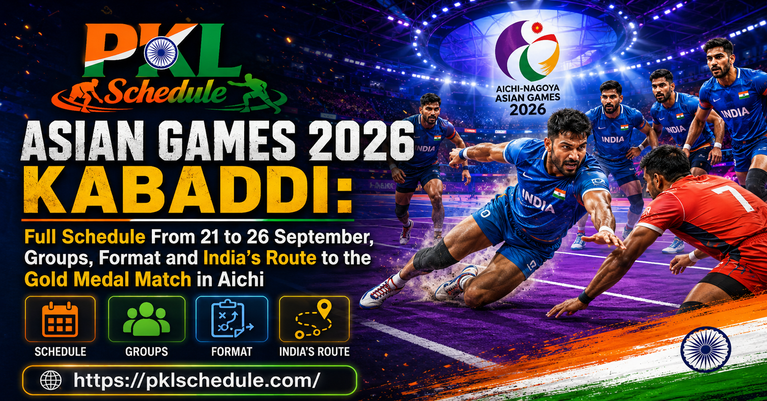
India at the Asian Games Kabaddi Event: Every Gold Medal Since 1990, the Unbeaten Run That Lasted 24 Years, and What Is at Stake for the Squad in Aichi
India at the Asian Games Kabaddi is the most successful nation in Asian Games kabaddi history, with eight gold medals in the men’s event. The men won gold at every edition from 1990 to 2014 without losing a single match, and reclaimed the title at the most recent Games by beating Iran 33–29 in the final.

India at the Asian Games Kabaddi record in one table
Kabaddi entered the Asian Games programme at Beijing 1990 as a men-only competition contested by six teams in a round-robin format. A women’s event was added to the programme in 2010. India have appeared in every edition since.
| Metric | India’s record |
|---|---|
| Men’s gold medals | Eight — the most of any nation |
| First appearance | Beijing 1990 |
| Consecutive golds, 1990–2014 | Seven editions, no matches lost |
| Most recent men’s final | Won 33–29 against Iran at Hangzhou |
| Status entering 2026 | Defending champions, men’s and women’s |
The unbeaten era: 1990 to 2014
Between Beijing 1990 and Incheon 2014, India played every Asian Games kabaddi match available to them and lost none of them. Seven consecutive gold medals, across seven editions, spanning twenty-four years.
It is difficult to find a comparable run in any continental team sport. What makes it more remarkable is the context: kabaddi during most of that period had no professional domestic league, no franchise infrastructure, no television money and no full-time contracts. India won because of depth in the state and railway systems, not because of a professional pipeline.
The structural reason for the dominance was simple. Kabaddi’s talent base in India — Haryana, Punjab, Uttar Pradesh, Maharashtra and the railway teams — was orders of magnitude deeper than anywhere else in Asia. Other nations were fielding representative sides. India was fielding the best twelve players from a country where hundreds of thousands played the sport competitively.
Why the run ended
The gap closed, and it closed for reasons that were largely India’s own doing.
The launch of professional franchise kabaddi in India created a demand for foreign players. Iranian, Korean and Bangladeshi athletes were signed, paid professionally, coached by Indian staff, and exposed to Indian training methods for months at a time. They then went home and represented their national teams against India.
Iran benefited most visibly. A generation of Iranian defenders and all-rounders built their careers in the Indian league, learning the specific tactical vocabulary — corner positioning, chain formation, super tackle timing — that Indian teams relied on. Within a decade the technical gap had substantially narrowed.
This is a genuine dilemma for Indian kabaddi and one that rarely gets stated plainly: the professionalisation that made the sport commercially viable also professionalised its rivals. The same dynamic has played out in other sports where one nation’s domestic league becomes the global finishing school.
The Hangzhou recovery
The most recent Games produced the response. India beat Iran 33–29 in the men’s final to reclaim the title, and the women’s team also took gold. Both squads travel to Japan as defending champions.
A 33–29 scoreline tells you something about how the fixture has changed. India’s dominant-era finals were frequently won by double-digit margins. A four-point final is a contest, not a coronation. That is the standard the 2026 squad inherits.
The women’s competition
Women’s kabaddi joined the Asian Games programme in 2010, and India have been the reference point for the event since. The current squad, built around Ritu Negi and Pushpa Rana, defends a title in a group containing Iran, Japan and Bangladesh — the toughest of the two women’s pools.
The women’s competition at these Games features eight teams in two groups of four, with the top two from each group reaching the semi-finals. With only three group matches, the margin for error is narrower than in the men’s event.
What is at stake in 2026
Three things, in descending order of how often they get discussed and ascending order of how much they actually matter.
The medal itself. A ninth men’s gold would extend a record no other nation is close to. It would also be the first time India has successfully defended an Asian Games kabaddi title since the unbeaten era ended.
The squad transition. Only four players from the last gold medal team are in the current squad. This tournament is the first real test of whether the new generation of raiders — Ayan Lohchab, Devank Dalal, Ashu Malik — can produce in single-elimination international kabaddi rather than league fixtures.
The domestic consequence. This is the one almost nobody writes about. Performance here feeds directly into the PKL Season 13 auction, now expected in the second half of October. Franchises will bid having watched these players in continental competition. For a young raider without an established price, a medal-winning tournament is worth a substantial amount at the bidding table.
How Asian Games kabaddi differs from league kabaddi
Fans who follow the domestic league and then watch international kabaddi for the first time often find the rhythm unfamiliar. The rules are broadly the same but the game looks different, for three reasons.
Stakes change raiding behaviour. Single-elimination knockouts produce cautious raiding. Raiders take fewer risks, hunt bonus points rather than multi-point raids, and the do-or-die raid becomes the dominant scoring moment rather than one feature among many.
Defences are more conservative. League defences chase super tackles because the format rewards aggression across a long season. International defences protect the mat, accept the bonus point, and wait for the empty raid.
Officiating interpretations vary. Different referee panels apply lobby rules and pursuit calls with different thresholds than domestic officials, and teams that adapt quickly gain a real advantage.
If you want the underlying scoring mechanics, our guide to raid points and tackle points covers how each type of point is awarded.
Every nation that has medalled in Asian Games kabaddi
Beyond India, the consistent medal-winning nations in the men’s event have been Iran, Bangladesh, Pakistan and the Republic of Korea. Iran are the only side to have won men’s gold. Bangladesh and Korea have both taken multiple medals and both sit in the medal conversation again in 2026.
In the women’s event, Iran, Chinese Taipei, Thailand, Bangladesh and Japan form the competitive tier beneath India, with Chinese Taipei having come closest to an upset in recent editions.
Edition by edition: how the record was built
The shape of India’s Asian Games kabaddi record is unusual. It is not a story of gradual accumulation but of two distinct eras separated by a sharp break.
1990 to 2014 — total dominance. Seven consecutive gold medals across seven editions, with no matches lost. Kabaddi debuted at Beijing 1990 with six men’s teams playing a round-robin. India won. The format expanded, the field grew, opponents professionalised, and India kept winning. Twenty-four years without a defeat at continental level.
The break. The unbeaten run ended, and with it the assumption that Indian gold was automatic. This was the moment Indian kabaddi’s relationship with its own success changed. Selection became genuinely competitive, coaching structures were reviewed, and the national programme could no longer rely on depth alone.
The Hangzhou recovery. India reclaimed the men’s title with a 33–29 win over Iran in the final. The women also took gold. Both squads travel to Aichi-Nagoya as defending champions, but the four-point final margin is the number that matters: this is now a contest, not a formality.
The women’s medal record
Women’s kabaddi entered the Asian Games programme in 2010, and India have been the benchmark since. The programme has produced consistent medal returns and, more importantly, a domestic structure that feeds it.
The competitive picture has changed as the field has strengthened. Iran’s women’s programme has closed the gap significantly. Chinese Taipei pushed India to the final raid at a recent edition — a result that reframed how seriously the rest of the field is taken. Thailand, Bangladesh and Japan complete a competitive tier that did not meaningfully exist fifteen years ago.
India’s women’s group at these Games — Iran, Japan and Bangladesh — is a direct consequence of that strengthening. There is no longer a soft group available.
Why one country dominated a continental sport for so long
The structural explanation for India’s record is worth stating clearly, because it explains both the dominance and its decline.
Kabaddi in India was never a niche sport looking for participants. It was played at village level across Haryana, Punjab, Uttar Pradesh, Rajasthan and Maharashtra, organised through school competitions, state championships and the railway and services teams that historically employed athletes. The competitive base numbered in the hundreds of thousands.
Other Asian nations were building programmes from a standing start — identifying athletes from other sports, importing coaching, and fielding representative sides rather than selecting from genuine domestic depth. The gap in talent pool size was so large that tactical or coaching advantages elsewhere could not close it.
What changed was not India’s talent base. It was that professional franchise kabaddi gave foreign players access to Indian coaching, Indian training methods and months of competitive kabaddi at the highest level available anywhere. The pipeline India built for itself became a pipeline for its rivals.
What a ninth gold would mean
The immediate significance is the number. Nine men’s Asian Games golds would extend a record no nation is within reach of.
The more meaningful significance is the defence. India has not successfully defended an Asian Games kabaddi title since the unbeaten era ended. Winning back a title is a recovery; holding it is evidence that the recovery was structural rather than a single good tournament.
There is also a squad-transition dimension. With only four players returning from the last gold medal team, a successful defence would validate a selection philosophy that prioritised current domestic output over tournament experience. A failure would fuel the opposite argument, and would shape squad selection for the next cycle.
Records and milestones to watch in Aichi
Beyond the medal itself, a few individual and team markers are in play at these Games.
Consecutive appearances. This is kabaddi’s ninth straight Asian Games since 1990 — a continuity record among the non-Olympic disciplines on the programme.
India versus Iran head-to-head. The defining rivalry of modern international kabaddi. Because of the men’s draw, the two can only meet from the semi-finals onwards, which means any meeting is automatically a medal-deciding match.
First-time medallists. Chinese Taipei in the women’s event and Japan on home soil are the two most plausible candidates to break into the medal positions for the first time or after a long absence.
Frequently asked questions
How many gold medals has India won in Asian Games kabaddi?
Eight in the men’s event, more than any other nation. India have also won the women’s event multiple times since it was added in 2010.
When did kabaddi first appear at the Asian Games?
At Beijing 1990, as a men-only competition with six teams playing a round-robin format. The 2026 edition is kabaddi’s ninth consecutive appearance.
Has India ever lost an Asian Games kabaddi final?
India’s unbeaten run covered every edition from 1990 to 2014. The run ended subsequently, and India reclaimed the men’s title at the most recent Games by beating Iran 33–29.
Which country is India’s biggest rival in Asian Games kabaddi?
Iran. They are the only other nation to have won men’s gold and have been India’s most frequent final opponent in recent editions.
When was women’s kabaddi added to the Asian Games?
In 2010. India have been the dominant side in the event since its introduction.
Is kabaddi an Olympic sport?
No. Kabaddi is a continental multi-sport event discipline, contested at the Asian Games and Asian Indoor and Martial Arts Games, but it is not on the Olympic programme.
How many nations have won Asian Games kabaddi gold?
Only two have won the men’s title: India, with eight golds, and Iran. No other country has taken gold in the event since kabaddi joined the programme in 1990.
How long is an Asian Games kabaddi match?
Forty minutes, split into two twenty-minute halves with a five-minute interval — the same duration used in domestic league kabaddi.
About The Author