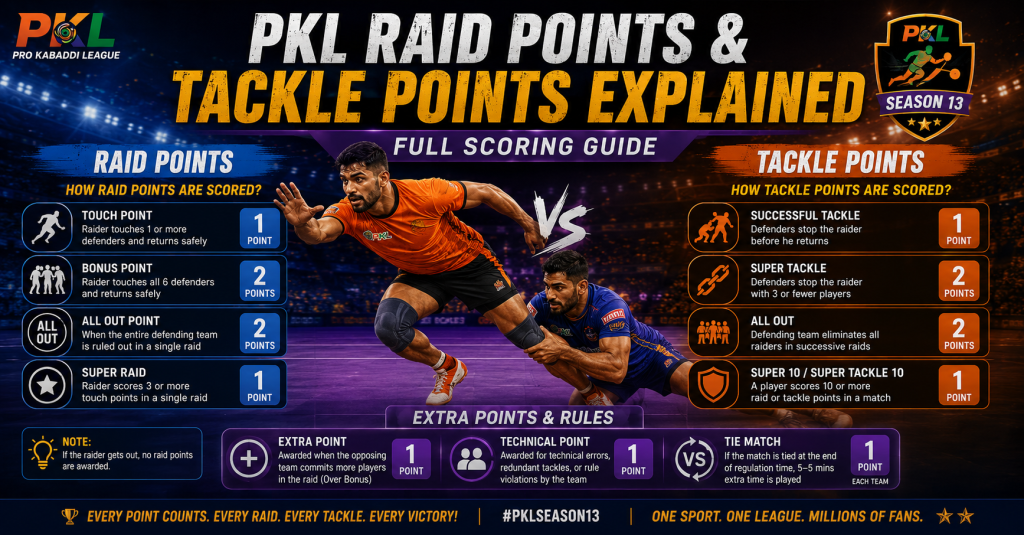
PKL Raid Points & Tackle Points Explained: Full Scoring Guide
Someone yells “Super 10” during a PKL match, the crowd loses its mind, and you are left nodding along while secretly wondering what number actually just happened. Kabaddi scoring looks confusing for exactly the first ten minutes anyone watches it. After that, it clicks, and it clicks hard.
PKL scoring works on two simple ideas: a raider scores points by touching defenders and getting back safely, while a defender scores points by stopping the raider before they can return. Every match is really just a tug of war between those two jobs, and the points table simply keeps score of who is winning that tug of war across the whole season.
This guide walks through every PKL Raid Points & Tackle Points scoring term you will hear during a broadcast, shows real Season 12 numbers so you can see the scoring system in action, and clears up a few things commentators often assume you already know. By the end, terms like Super Raid, All Out, and Do-or-Die will feel as normal to you as a goal or a home run does in other sports.
How Does PKL Raid Points & Tackle Points Work?
Every PKL match is a battle between seven raiders and seven defenders on each side, though only one raider crosses into the opponent’s half at a time. That single raider has to touch as many defenders as possible and sprint back across the mid-line before getting caught, all within a single breath, without ever inhaling.
If the raider makes it back safely, their team earns one point for every defender they touched, plus a bonus point if they crossed the bonus line while at least six defenders were on the mat. If the defenders catch the raider before they get back, the defending team earns a point instead, and the raider is out.
Add up every touch, every bonus, and every tackle across 40 minutes, and you get the final score. Stack up every match’s final score across the whole season, and you get the points table. It really is that straightforward once you separate the two jobs, raiding and defending, in your head.
What Is a Raid Point?
A raid point is what a raider earns for successfully touching a defender and returning to their own half without getting tackled. Simple as that sounds, there are actually a few different ways a raider can rack up points during a single raid.
Touch Points
The most basic raid point comes from a clean touch. Reach out, tag a defender with any part of your body, and get back safely, and that is one point per defender touched. Touch three defenders in one raid and make it back, and that raid alone is worth three points.
Defenders obviously do not make this easy. They dodge, they grab, they form a wall to block the raider’s escape route, which is exactly why a raid that looks simple on a replay can actually be a genuinely difficult, split-second decision made under pressure.
Bonus Points
A bonus point comes from crossing a marked line on the mat called the bonus line, but only when the defending team has six or more players still on the court. Cross that line while the defense is at full strength, and the raider’s team picks up an extra point on top of anything else they scored.
This rule rewards bold raiding. A raider who dashes far into enemy territory while the defense is fully loaded takes a bigger risk, and the bonus point is the league’s way of paying that risk off when it works.
Super Raid
A Super Raid happens when a single raider scores three or more points in one raid. It is one of the most exciting moments in any match, since it usually means a raider dodged multiple defenders, touched several of them, and still made it back in one piece.
Commentators get genuinely loud during a Super Raid, and honestly, they have earned the right to. Pulling off three or more points in a raid that lasts maybe five seconds takes serious skill, timing, and more than a little nerve.
What Is a Tackle Point?
A tackle point is what defenders earn for stopping a raider before they can get back across the mid-line. Just like raiding, there is more than one technique defenders use to make this happen, and each one has its own name.
Ankle Hold, Dash, and Block
An ankle hold is exactly what it sounds like: a defender grabs the raider’s ankle or leg and holds on tight enough to stop them from crossing back. It looks simple, but timing it wrong means the raider slips free and the whole tackle attempt fails completely.
A dash involves a defender charging low and fast to knock the raider off balance before they can escape. A block is more about teamwork, with two or more defenders forming a human wall that the raider physically cannot get past no matter how quick their footwork is.
Whichever technique gets used, the result is the same. If the raider does not make it back to their own half, the defending team earns one tackle point, and the raider is out for that raid.
Super Tackle
A Super Tackle happens when a team has three or fewer defenders on the mat at the moment they successfully stop a raider. Pulling off a tackle while short-handed is much harder, so the league rewards it with an extra bonus point on top of the normal tackle point.
This rule matters a lot late in matches, when teams often find themselves down to just a few defenders after several players have already been tackled out earlier in the game. A Super Tackle in that moment can completely flip momentum in a single play.
What Is a Do-or-Die Raid?
A Do-or-Die raid happens when a raider’s team has gone two raids in a row without scoring a single point. On that third raid, the raider absolutely must score, or they get tackled out automatically, even if the defenders barely touch them.
This rule stops teams from stalling by sending raiders out just to waste time without actually attacking. It forces action, which is exactly why PKL matches rarely have a dull stretch for more than a couple of minutes at a time.
Do-or-Die raids tend to produce some of the tensest moments in any match. A raider walking out under that pressure, knowing a scoreless raid means an automatic exit, has to make a decision fast, and that pressure often leads to either a brilliant escape or a costly mistake.
Coaches sometimes send out a specialist raider specifically for these situations, someone known for staying calm under pressure rather than their usual go-to scorer. That small lineup swap has decided more than a few close matches over the years, even though it rarely gets talked about outside of post-match analysis.
What Happens When a Player Gets Tackled Out?
When a raider gets tackled, they do not sit out for the rest of the match. They head to the sideline and wait for their own team to score a point through either a raid or a tackle, at which point one player from the sideline gets to rejoin the mat.
This revival system keeps matches fast-paced, since teams are never stuck playing a full man down for very long if they keep scoring. It also means a team on a scoring streak snowballs quickly, bringing players back one after another while the other side struggles to keep seven players on the mat at once.
That snowball effect is exactly what leads to an All Out, where one team’s entire lineup ends up sitting on the sideline at the same time because they could not score fast enough to bring anyone back. Once that happens, the opposing team collects 2 bonus points on top of everything else.
How the PKL Points Table Is Calculated
Team standings on the PKL points table come down to total points earned across every league-stage match, not just wins and losses the way many other sports work. A win in the league stage is worth two points to the team, since Season 12 introduced a simplified scoring system for match results.
If the score is tied after the shootout tie-breaker, whichever team wins that shootout gets the two points, since Season 12 removed the possibility of a drawn match completely. This change made the table much easier to read, since every single match now produces a clear winner.
Score difference also plays a role when teams are tied on points. Puneri Paltan finished first on the Season 12 league table partly because of a plus-88 score difference, built from consistently winning matches by wide margins rather than scraping by with narrow victories.
Why PKL Simplified Its Scoring System
Older PKL seasons allowed matches to end in a tie, with both teams walking away with a single point each. Season 12 scrapped that entirely, moving to a simple two-points-for-a-win system with a shootout to break any deadlock, no exceptions.
Mashal Sports made this change for a clear reason. Ties made the points table harder to read and occasionally left fans confused about how two teams with the same number of wins could still be ranked differently. A straight two-points-per-win system fixes that instantly, since every match now produces a clean, obvious outcome.
The shootout itself adds its own kind of scoring, separate from normal raid and tackle points. Both teams field seven players, the baulk line doubles as a bonus line for the shootout, and five different raiders must take part, so no single star player can win a shootout entirely on their own.
Fans generally welcomed the change, since tied matches always felt like a bit of an anticlimax after 40 minutes of nonstop action. A shootout, by contrast, adds one more burst of drama right at the moment when a match would otherwise have just fizzled out.
Common Scoring Mistakes New Fans Make
A few scoring mix-ups come up again and again with people just getting into kabaddi, so it is worth clearing them up here before you find yourself arguing about it during a match with someone who has watched the sport for years.
“A Raider Only Scores if They Touch Someone”
Not quite true. A raider can also score just by crossing the bonus line safely, without touching a single defender, as long as six or more defenders are on the mat at that moment. That bonus point counts the same as a touch point on the scoreboard.
“Getting Tackled Means the Raider’s Team Loses a Point”
This trips up a lot of newer fans. A tackle does not subtract a point from the raiding team. It simply gives one point to the defending team instead, and the raider heads to the sideline until their team scores again and brings them back.
“Tackle Points and Raid Points Count the Same Way Toward MVP”
Not always. Awards like Season 12’s MVP, which went to defender Fazel Atrachali over several high-scoring raiders, show that judges weigh consistency, game situation, and overall impact, not just the raw total of points on a stat sheet. A raider with flashy numbers does not automatically win over a defender who quietly shaped every close match all season.
PKL Season 12 Top Raiders and Top Defenders
Numbers make all of this much easier to picture, so here is exactly how the individual stat race played out across Season 12’s league stage and playoffs combined.
| Category | Player | Team | Total |
|---|---|---|---|
| Most Raid Points | Ayan Lohchab | Patna Pirates | 316 raid points |
| Most Tackle Points | Navdeep Singh | Patna Pirates | 73 tackle points |
| Top Scorer Overall | Ayan Lohchab | Patna Pirates | 324 total points |
| MVP (Most Valuable Player) | Fazel Atrachali | Dabang Delhi K.C. | 52 tackle points, MVP award |
Notice something interesting there. Patna Pirates produced both the top raider and the top defender of the entire season, yet they did not win the title. That is a good reminder that individual stats and team success do not always line up perfectly in PKL, since a champion needs consistent contributions across the whole squad, not just one or two standout performers.
All-Time PKL Raid Point and Tackle Point Records
Zoom out from a single season, and a couple of names dominate the league’s entire history. Pardeep Narwal holds the record for most career raid points in PKL, with 1801 total raid points and 1250 successful raids across his time in the league, along with the record for most total points ever scored by any player.
On the defensive side, Fazel Atrachali holds the all-time tackle point record with 560 career tackle points, built from 509 successful tackles. Both of these records have stood for years now, and neither looks close to falling anytime soon given how much raiding and defensive styles keep changing season to season.
What makes these two records especially interesting is how different they are in nature. Narwal built his record through raw volume and aggression across many seasons with Patna Pirates, while Atrachali built his through positioning, patience, and reading raiders better than almost anyone else who has ever played the sport professionally.
Neither player needs flashy highlight reels to justify their status among fans. Coaches across the league still study clips of both of them when training younger players, which says everything about how much these two records still matter years after they were first set.
Why Raid Points Get More Attention Than Tackle Points
Watch any PKL highlight reel and you will notice raiders get most of the spotlight. That makes sense on a basic level, since raid points usually pile up faster than tackle points, and flashy dodges make for better television than a defender simply holding onto an ankle.
Even so, defenders arguably have the harder job. A raider only needs to succeed once per raid to score, but a defender has to read the raider’s movement, react in a split second, and coordinate with teammates, often while the raider has every advantage of knowing exactly which direction they plan to move. That imbalance is part of why great defenders earn so much respect inside the sport, even when the scoreboard does not always show it.
Ask any coach which wins championships, and most will tell you defense does the heavy lifting late in a tight match. Fazel Atrachali winning the Season 12 MVP award over several high-scoring raiders is proof that the league itself recognizes this, even if raiders still get more highlight reel time on social media.
None of this means raiders get too much credit, though. A raider carries a genuinely brutal physical and mental load every single time they step across that mid-line, knowing seven defenders are watching their every move and waiting for the smallest mistake to end their raid instantly.
Table: PKL Scoring Cheat Sheet
| Term | Points Earned | How It Happens |
|---|---|---|
| Touch Point | 1 point per defender | Raider touches a defender and returns safely |
| Bonus Point | 1 point | Raider crosses the bonus line with 6+ defenders on the mat |
| Super Raid | 3+ points | Raider scores 3 or more points in a single raid |
| Tackle Point | 1 point | Defenders stop the raider from returning safely |
| Super Tackle | 2 points | Defenders make a tackle with 3 or fewer players on the mat |
| All Out | 2 bonus points | One team tackles every opposing player out at once |
Print this table out, tape it to your wall, and you will never need to ask “wait, what just happened” during a PKL match again. Even a first-time viewer can follow an entire match using nothing but these six rows.
Keep this table close by during your next PKL match. It answers almost every “wait, what does that mean” question a first-time viewer usually has within the opening few minutes.
Frequently Asked Questions
What is a Super 10 in kabaddi?
A Super 10 happens when a raider scores 10 or more raid points in a single match. It is one of the biggest individual milestones a raider can hit and usually gets a special mention on the broadcast the moment it happens.
How many points is a Super Tackle worth?
A Super Tackle is worth 2 points instead of the usual 1, since it happens when defenders successfully stop a raider while only having 3 or fewer players left on the mat.
What happens if a raider does not touch any defender?
If a raider crosses into the opponent’s half and does not touch a single defender before returning, or gets tackled without scoring, they earn zero points for that raid, and the raid is considered unsuccessful.
Who holds the record for most raid points in PKL history?
Pardeep Narwal holds the all-time record with 1801 career raid points, along with the most total points scored by any player across the league’s history.
What is an All Out in kabaddi?
An All Out happens when one team manages to tackle every single opposing player out of the game at the same time. The team that pulls this off earns 2 bonus points on top of whatever tackle points they already scored during that sequence.
What is a Do-or-Die raid?
A Do-or-Die raid happens on a raider’s third straight raid without scoring. If they fail to score on that raid, they are automatically tackled out, even if the defenders barely touch them. It exists to stop teams from stalling.
Can a match end in a tie in PKL?
Not anymore. Since Season 12, every match that is tied after regulation time moves into a five-raid shootout, and whichever team wins that shootout takes the two league points for the win.
Related Guides
Ready to see these stats in action? The live PKL points table tracks every team’s standing throughout the season. If you want to train like the pros putting up these numbers, check our PKL fitness training tips for raiders and defenders. And to see how these individual stats connect to the playoff race, our PKL playoffs schedule guide covers the whole knockout format step by step.