Kabaddi International Events 2026: Full Calendar From Iran to Saudi Arabia
Kabaddi fans usually plan their year around one thing: the PKL calendar. In 2026, that is only half the story. India’s raiders and defenders are about to spend the year hopping between four different countries, chasing four different trophies, and none of them are PKL.
Kabaddi’s confirmed international calendar for 2026 includes four major events: the Junior World Championship (Boys) in Isfahan, Iran from June 5 to 11, the 20th Asian Games in Nagoya, Japan from September 21 to 26, the Commonwealth Kabaddi Championship in Ahmedabad, India from October 10 to 18, and the 6th Asian Indoor and Martial Arts Games in Riyadh, Saudi Arabia from November 28 to December 7.
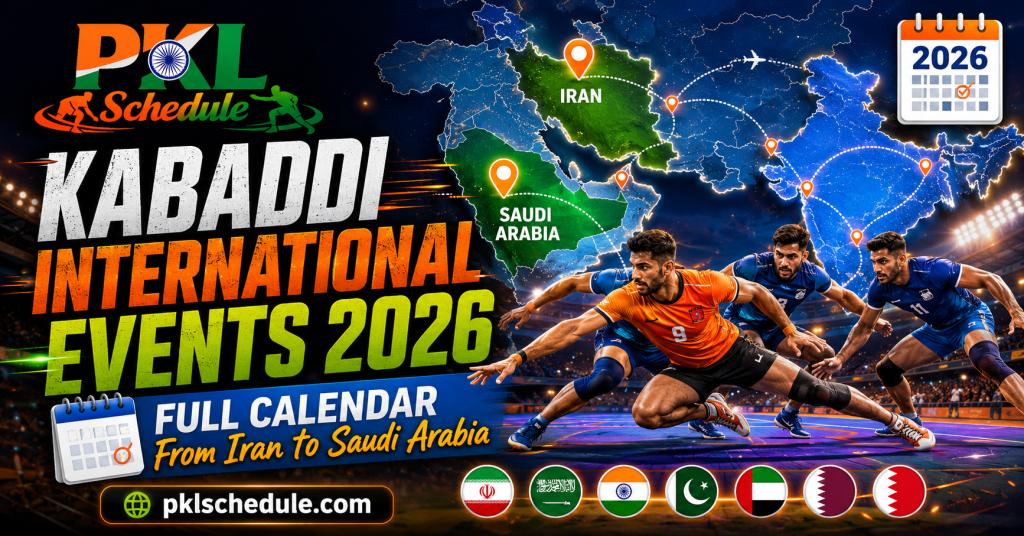
That is a packed calendar by any standard, and it matters for more than just the players competing. Every one of these events pulls top talent away from domestic kabaddi for weeks at a time, which has real knock-on effects for how PKL Season 13 gets scheduled. This guide breaks down each event, why it matters, and how it all fits together.
Why Kabaddi International Events Calendar Matters This Year
Most years, kabaddi fans only have to track one or two international events alongside the domestic PKL season. 2026 is different. Four separate tournaments, spread across four different countries, all land within roughly six months of each other.
For India, this is a genuine opportunity to show dominance across multiple formats and age groups at once. Winning a junior title, defending an Asian Games crown, and hosting a Commonwealth championship all in the same calendar year would be a statement about how far the sport’s talent pipeline has come.
For PKL specifically, this calendar creates a scheduling headache. Several PKL stars represent India at the senior level, and pulling them away for the Asian Games in particular means Season 13’s exact dates may depend on how India’s national program plans around this busy stretch.
Junior World Championship (Boys): June 5 to 11, Isfahan, Iran
The year kicks off with the Junior World Championship for boys, held in Isfahan, Iran, from June 5 to 11, 2026. This tournament exists specifically to give younger players international experience before they are old enough to break into senior national teams.
Iran has hosted kabaddi’s biggest international events more than once, and Isfahan continues that tradition. The country’s own domestic kabaddi program is one of the strongest outside India, which makes any tournament held there a genuine test for visiting teams, not just a formality.
Why the Junior Championship Matters Beyond the Trophy
For India, this tournament works as a scouting pipeline as much as a competition. Coaches and selectors watch closely to identify which young raiders and defenders might be ready for senior national team consideration in the next two or three years.
Several current PKL stars came through junior international tournaments exactly like this one before making their name at the senior level. A standout performance in Isfahan can genuinely change a young player’s career trajectory, opening doors to state-level trials and eventually PKL auction interest.
The format typically brings together a wide mix of nations, not just the usual kabaddi powerhouses. Countries like Thailand, Malaysia, and Turkmenistan have fielded junior teams at past editions, showing how the sport’s youth pipeline extends well beyond South Asia and the Middle East.
20th Asian Games: September 21 to 26, Nagoya, Japan
The biggest event on this entire calendar is the 20th Asian Games, with kabaddi’s specific fixtures set for September 21 to 26, 2026, at the Tōkai Citizens Gymnasium in Aichi Prefecture, Japan. This is kabaddi’s ninth consecutive appearance at the Asian Games, a streak that stretches all the way back to the sport’s Asian Games debut in 1990.
Both men’s and women’s kabaddi will be contested, and India enters as the defending champion in both events. That is not a small thing to defend. India has been the dominant force in Asian Games kabaddi for years, and every rival nation treats beating India here as the biggest possible statement they can make.
Why the Asian Games Matter So Much for Kabaddi
Unlike PKL or most domestic tournaments, the Asian Games gives kabaddi a genuine multi-sport stage, sitting alongside athletics, swimming, and dozens of other disciplines under one continental banner. That visibility matters enormously for a sport still trying to grow its audience outside South Asia.
Continued inclusion in the Asian Games also helps kabaddi’s broader push toward eventual Olympic recognition, since consistent participation in major multi-sport events is often part of the case international federations make when lobbying for wider global status.
Competition-wise, expect serious challenges from Iran, Japan, and South Korea. Iran in particular has closed the gap with India significantly over the past decade, and a home-soil advantage in nearby conditions could make Japan a tougher out than usual in the men’s draw.
India’s Title Defense
Defending a title always carries different pressure than chasing one. India’s kabaddi programs, both men’s and women’s, will enter Nagoya as favorites, but favorites carry a target that every other nation is aiming directly at.
Selection for this squad will likely draw heavily from players with strong recent PKL form, since national selectors typically look at current domestic league performance as one of the clearest signals of who is playing their best kabaddi right now.
Commonwealth Kabaddi Championship: October 10 to 18, Ahmedabad, India
Right after the Asian Games wraps up, attention shifts back to home soil for the Commonwealth Kabaddi Championship, scheduled for October 10 to 18, 2026, in Ahmedabad, India. Playing host gives India a natural advantage, both in terms of crowd support and reduced travel fatigue compared to international opponents.
This event carries extra significance beyond just another trophy. Kabaddi’s inclusion discussions for the 2030 Commonwealth Games have made this specific championship a genuine proving ground, with some fans and officials treating strong participation and organization here as a building block toward that longer-term goal.
A Short Turnaround From the Asian Games
Squeezing a major tournament in mid-October, just weeks after the Asian Games wraps up in late September, is a tight turnaround for any athlete. Fatigue management becomes a real factor here, and squad rotation between the two events would not be surprising for teams managing player workload carefully.
For fans, this back-to-back scheduling actually creates a nice narrative thread. Watching how the same core group of Indian players perform just weeks apart, first away in Japan and then at home in Ahmedabad, gives a clear read on squad depth and conditioning heading into the back half of the year.
Building Toward 2030
Kabaddi has never appeared at the Commonwealth Games itself, despite strong support from India and other member nations with active kabaddi programs. Events like this Commonwealth Championship function as a demonstration of organizational readiness and competitive depth, both factors that matter when a sport is lobbying for future inclusion.
A well-run, well-attended tournament in Ahmedabad this October would add real weight to that ongoing push, especially with 2030 now firmly on the sport’s long-term radar.
6th Asian Indoor and Martial Arts Games: November 28 to December 7, Riyadh, Saudi Arabia
The international calendar closes out with the 6th Asian Indoor and Martial Arts Games, held in Riyadh, Saudi Arabia, from November 28 to December 7, 2026. This event groups kabaddi alongside a range of indoor and combat sports under one multi-sport banner, similar in spirit to the Asian Games but with its own distinct identity and host rotation.
Saudi Arabia hosting a major kabaddi event is itself a notable development. The Gulf region has invested heavily in hosting major multi-sport competitions in recent years, and kabaddi’s inclusion here reflects the sport’s gradual expansion into markets that historically had little connection to it.
A Late-Season Test of Squad Depth
By the time this tournament rolls around, India’s kabaddi programs will have already been through the Junior Championship, the Asian Games, and the Commonwealth Championship earlier that same year. Fielding a fresh, competitive squad for a fourth major event in seven months is a genuine test of how large India’s talent pool actually runs.
Expect rotation here more than at any other event on this calendar. Coaches often use late-year indoor games as an opportunity to test emerging players against real international competition, rather than risking burnout among the same core group that carried the load all year.
What This Means for Fans Planning to Follow Along
Four events across four countries means four very different viewing experiences for fans trying to follow along from home. Broadcast coverage, time zones, and streaming availability will vary a lot depending on which tournament you are trying to watch.
The Asian Games will most likely get the widest broadcast coverage of the four, given its status as a major multi-sport event with broad international media rights deals already in place. Expect Star Sports and JioHotstar to carry extensive coverage of India’s kabaddi matches specifically, alongside the rest of the Games.
The Commonwealth Kabaddi Championship, being hosted on home soil in Ahmedabad, should also be easy to follow for Indian audiences, likely with strong domestic broadcast and streaming support similar to how PKL itself gets covered. The Junior Championship in Iran and the Asian Indoor Games in Saudi Arabia may see more limited coverage outside dedicated kabaddi channels and federation social media accounts.
If you want the most reliable updates throughout this busy stretch, following the Amateur Kabaddi Federation of India and the International Kabaddi Federation directly on social media tends to surface schedule confirmations and squad announcements faster than general sports news coverage, which often treats kabaddi as a secondary story compared to bigger multi-sport headlines.
How Squad Selection Works Across Multiple Tournaments
Fielding competitive squads across four major events in a single calendar year is a genuine logistical challenge for India’s kabaddi selectors. Different tournaments call for different approaches to squad building, and understanding that distinction helps make sense of why certain star names might sit out one event while playing a bigger role at another.
The Junior Championship naturally draws from a completely separate talent pool, since it is age-restricted and exists specifically to develop future senior players rather than showcase current stars. Selectors here focus on long-term potential over immediate results, even if that occasionally costs India a match it might have won with a stronger, more experienced lineup.
The Asian Games, by contrast, will most likely see India’s strongest possible senior squad, given the title defense on the line and the continental prestige attached to the event. Expect current PKL standouts with strong recent form to make up the bulk of this roster.
For the Commonwealth Championship and the Asian Indoor Games, squad rotation becomes more likely simply due to the tight turnaround and physical toll of competing at that level repeatedly within a few months. Coaches often use these later events to manage player workload, resting key Asian Games contributors while giving other squad members useful international minutes.
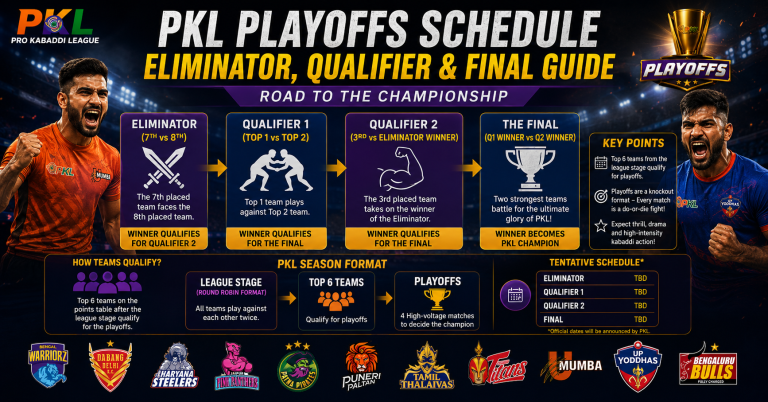
Full 2026 International Kabaddi Calendar
| Event | Dates | Location |
|---|---|---|
| Junior World Championship (Boys) | June 5 – 11, 2026 | Isfahan, Iran |
| 20th Asian Games (Men & Women) | September 21 – 26, 2026 | Nagoya, Japan |
| Commonwealth Kabaddi Championship | October 10 – 18, 2026 | Ahmedabad, India |
| 6th Asian Indoor and Martial Arts Games | November 28 – December 7, 2026 | Riyadh, Saudi Arabia |
Bookmark this table. Four major events, four different countries, and roughly six months between the first and the last, this is the busiest confirmed international stretch kabaddi has had in years.
How These Events Could Affect PKL Season 13
This international calendar does not exist in a bubble. PKL Season 13 is currently expected to start around mid-December 2026, and that timing lines up almost exactly with the end of the Asian Indoor and Martial Arts Games in Riyadh.
The Asian Games window in September is arguably the bigger concern for PKL scheduling. Several PKL stars represent India at the senior level, and pulling them away for a two-week tournament right in the middle of what would normally be prime league-stage season makes an earlier PKL start date far less practical this year.
Our detailed breakdown of this exact overlap, along with the full expected Season 13 timeline, is covered in our PKL Season 13 start date guide, which explains why Mashal Sports is likely waiting on this international calendar to firm up before locking in official PKL dates.
The World Super Kabaddi League: A New Global Angle
Beyond these four confirmed events, 2026 also brings the World Super Kabaddi League, a new franchise-based tournament planned for Dubai. Unlike the Junior Championship, Asian Games, or Commonwealth Championship, this is not a national team competition. It is a club-style league built specifically to expand kabaddi’s visibility beyond its traditional South Asian base.
A Dubai-based franchise league sitting alongside PKL creates an interesting new situation for players. More overseas playing opportunities generally means more income potential and more exposure, though it also raises scheduling questions similar to what cricket players face when balancing IPL commitments against other global T20 leagues.
It is too early to say how much overlap this league will have with PKL’s own player pool, but any format explicitly designed to increase global visibility for kabaddi is worth watching closely as the sport keeps expanding its reach.
Why 2026 Is Shaping Up to Be a Landmark Year
Stack all of this together, and 2026 looks like one of the most important years in kabaddi’s modern history. A junior tournament feeding the talent pipeline, an Asian Games title defense on the sport’s biggest continental stage, a home Commonwealth Championship building toward 2030 ambitions, a new Gulf-hosted multi-sport event, and a brand new international franchise league, all within the same calendar year.
Individually, each event matters on its own terms. Together, they represent a sport actively pushing outward, both geographically and structurally, in a way that few other combat or contact sports outside the Olympic core manage to do in a single year.
For fans, that means a genuinely packed year of following India’s kabaddi programs across multiple age groups and formats, not just the usual PKL rhythm most casual followers are used to tracking.
Frequently Asked Questions
What are kabaddi’s major international events in 2026?
Four confirmed events make up kabaddi’s 2026 international calendar: the Junior World Championship (Boys) in Isfahan, Iran, the 20th Asian Games in Nagoya, Japan, the Commonwealth Kabaddi Championship in Ahmedabad, India, and the 6th Asian Indoor and Martial Arts Games in Riyadh, Saudi Arabia.
When does kabaddi’s Asian Games competition take place in 2026?
Kabaddi’s specific fixtures at the 20th Asian Games run from September 21 to 26, 2026, at the Tōkai Citizens Gymnasium in Aichi Prefecture, Japan, within the broader Asian Games window of September 19 to October 4.
Is India the defending champion in Asian Games kabaddi?
Yes. India enters the 2026 Asian Games as the defending champion in both the men’s and women’s kabaddi events, continuing a long run of dominance in the sport at this continental level.
Could these international events affect the PKL Season 13 schedule?
Yes, potentially. Several PKL players represent India at the senior level, and the Asian Games in particular falls right in a window that could otherwise host early PKL Season 13 matches, which may be part of why an official Season 13 start date has not been confirmed yet.
What is the World Super Kabaddi League?
The World Super Kabaddi League, or WSKL, is a new franchise-based kabaddi league planned for Dubai in 2026, designed to expand the sport’s international visibility through a club-style format rather than national team competition.
Related Guides
Curious how this international calendar connects to the domestic season? Our PKL Season 13 start date guide covers the expected timeline in full detail. For a refresher on how India’s biggest domestic stars stack up statistically, our raid points and tackle points guide explains the scoring system behind every headline number. And for the complete picture of PKL’s own history heading into this busy year, check our PKL season history guide.